

Email marketing remained fairly stable throughout 2025, although sending strategies are changing. The fifth edition of the GDMA International Email Benchmark 2026 shows that marketers are increasingly spreading email campaigns throughout the year, rather than relying on traditional peak moments.
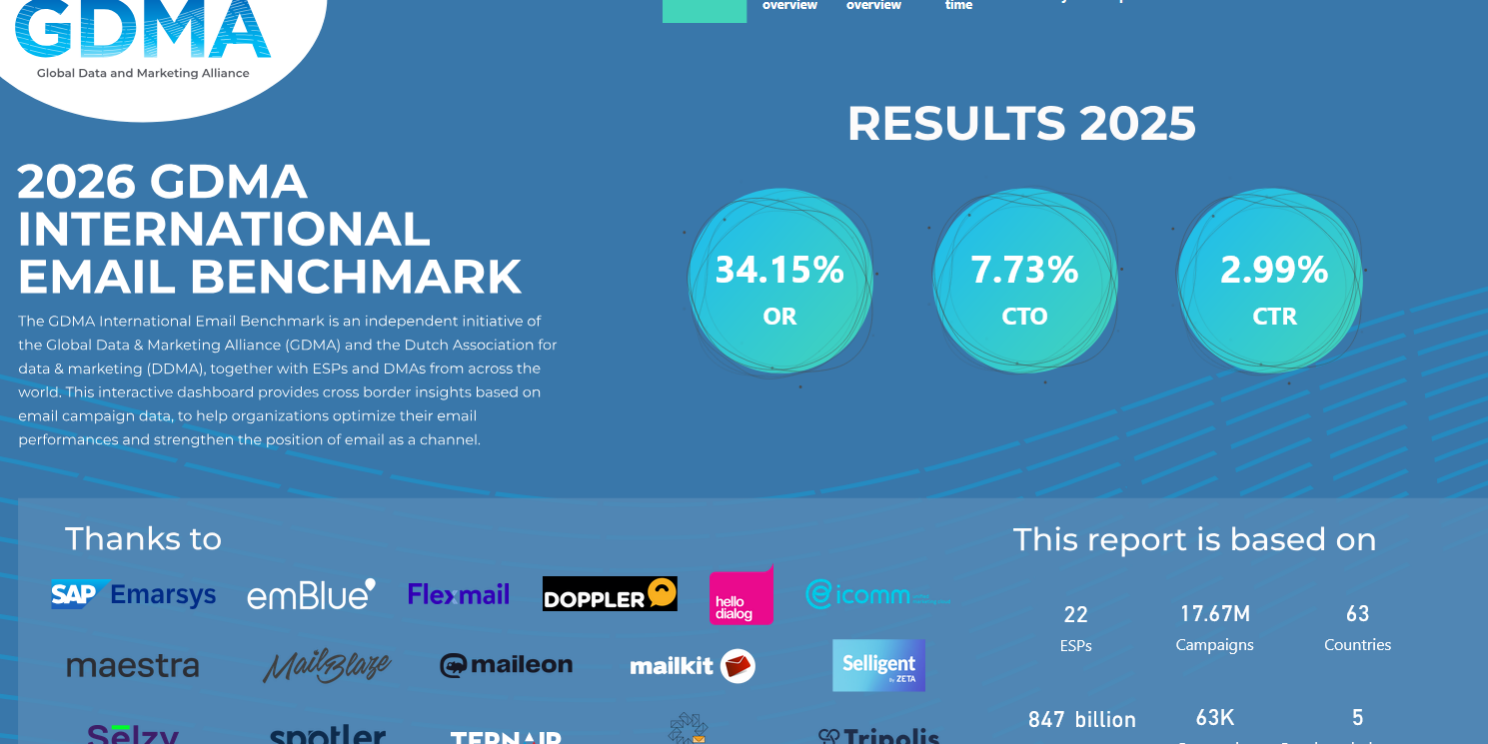
Globally, the Acceptance Rate remained stable at 98.6%, while the Unique Open Rate (34.2%) returned to 2023 level. The Click to Open Rate (7.7%) and Click Through Rate (3%) also showed a slight recovery. Consumers appear to be opening commercial emails more frequently again and are also slightly more likely to click through after receiving them, with content and relevance continuing to play a key role in engagement.
Go to the interactive dashboard
From end-of-year peak to always-on email strategy
The benchmark shows that email campaigns are increasingly being spread throughout the year. While Q4 traditionally showed clear peaks driven by Black Friday and holiday campaigns, sending volumes in 2025 were distributed more evenly.
Globally, the peak in sending volumes now starts as early as July, while the share of campaigns sent towards November and December has slightly decreased. By spreading campaigns more evenly, organisations aim to become less dependent on peak moments (which clutter inboxes leading to potentially lower open rates) and remain relevant in consumers’ inboxes throughout the year.
More distribution across sending days
A shift is also visible in the choice of sending days. Globally, campaigns are increasingly being sent on both Tuesdays and Thursdays, whereas Thursday used to be the dominant sending day.
In addition, the share of campaigns sent during weekends is growing worldwide, aligning with the trend towards continuous visibility in the inbox.
About the GDMA International Email Benchmark 2026
The GDMA International Email Benchmark 2026 is based on anonymised campaign data from the period 2021–2025. For this edition, 15 Email Service Providers (ESPs) contributed data: Doppler, emBlue, Flexmail, Hellodialog, ICOMM mkt, Maestra.io, MailBlaze, Maileon, Mailkit, Marigold, SAP/Emarsys, Selzy, Spotler (including Tripolis), Ternair and TouchBase Pro. Across multiple editions, the benchmark now represents data from 22 ESPs. The 2026 update includes data from 17.7 million email campaigns (compared to 11.4 million in the 2025 edition) and 847 billion sent emails (up from 521 billion in the previous edition). The benchmark covers 61 countries across Europe, North America, Central and South America, APAC, Africa, and the Middle East. The GDMA International Email Benchmark is an independent initiative by the Global Data & Marketing Alliance (GDMA) and the Dutch Data Driven Marketing Association (DDMA).
Want to learn more about the study or participate in a future edition? Please contact Robin de Wouters (GDMA) via rdewouters@fedma.org or Nanda Appelman (DDMA) via nandaappelman@ddma.nl.